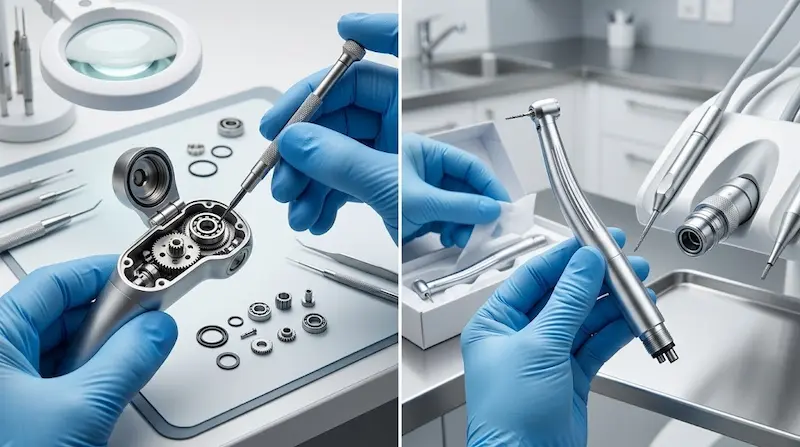
A dental handpiece rarely fails all at once. More often, the warning signs start small: a drop in power, extra vibration, unusual noise, weaker spray or a bur that no longer feels fully secure. In daily practice, those changes matter quickly because they can affect precision, interrupt treatment and force last-minute adjustments during a procedure.
That is why the decision should not start with price alone. When practices review offers for dental micromotors parts, the real issue is whether the part matches the motor, the attachment, the coupling and the maintenance routine already in use. A component that fits poorly or solves only one visible symptom can end up creating more downtime than the original fault.
In most cases, the useful question is simple: is the problem limited and repairable, or is the unit already showing a broader pattern of wear? That difference matters because repairing the wrong instrument too many times can cost more than replacing it with a stable option that fits the rest of the setup.
Dental handpieces and the repair or replace decision
Dental handpieces should be evaluated through performance, cooling, fit and service history. Repair is usually the right move when the fault is specific and the rest of the unit is sound. Replacement becomes the stronger choice when wear is repeated, performance is unstable or the instrument no longer works well with the rest of the system.
A quick review should focus on four points:
- Power and stability: whether the unit keeps normal performance during use
- Cooling and spray: whether water flow is even and sufficient
- Bur retention: whether the bur locks firmly and runs without wobble
- Service record: whether the same issue has already appeared before
What a dental handpiece includes
The term dental handpiece can sound simple, but in practice it covers more than the instrument the clinician holds. Its performance may depend on a turbine, an air motor or an electric micromotor, plus the attachment connected to it.
That distinction matters because not every problem starts in the same place. A loss of power may come from the motor, but it can also be linked to the attachment, the coupling, the spray channels or worn seals. In the same way, a handpiece that feels unstable may not need a full replacement if the real problem is concentrated in one section.
This is where the broader equipment around the unit also comes into play. Air delivery, water supply, couplings, hoses and the fit between components all influence how a handpiece behaves during treatment. Looking only at the visible body of the instrument can lead to the wrong diagnosis.
Why maintenance and sterilization matter
A handpiece is not just a rotating tool. It is also a reusable clinical device that must be cleaned, lubricated and heat-sterilized according to the manufacturer’s instructions between patients. That makes maintenance part of the technical discussion, not a separate issue.
A repair that restores rotation but leaves doubts about cooling, sealing or routine reprocessing is not a complete solution. The same applies to replacement parts: if they do not support normal maintenance and predictable daily use, the practice may be trading one fault for another.
When repair is usually the sensible option
Repair tends to make sense when the damage is limited and the main structure of the unit is still reliable. That may include worn seals, blocked spray ports, bearing wear, reduced light output, chuck problems or loss of performance linked to one replaceable section.
In those cases, the key is to confirm that the fault is truly localized. If the handpiece body is sound, the motor still performs properly and the replacement part is clearly compatible, a repair can restore normal function without forcing a larger investment.
A targeted repair is often reasonable when it can bring back:
- stable rotation
- proper cooling
- firm bur retention
- normal handling during routine clinical use
When replacement is the better option
Replacement becomes more convincing when faults start stacking up. Noise, heat, vibration, leakage and weak performance do not always point to the same internal problem, but together they usually suggest that wear is no longer isolated.
At that stage, repeated service can stop being efficient. A practice may pay for one repair, then another, and still keep losing time to interruptions, checks and inconsistent performance. In that scenario, the cost is not only the service invoice. It is also the disruption created by a tool that no longer behaves predictably.
Replacement should also be considered when compatibility has become part of the problem. Older units may still function, but if the motor, coupling or attachment standard no longer fits the rest of the setup well, the practice may be maintaining a weak point instead of solving it.
The mistake that often leads to false savings
One common mistake is to compare only today’s repair cost with today’s replacement cost. That is too narrow for a clinical tool used every day.
A better comparison includes expected service life after repair, the chance of the same fault returning, the fit with the current setup and the practical cost of downtime. A cheaper repair can stop looking cheap if it leads to another service call a short time later.
What to check before approving a repair
Before sending a handpiece for service or ordering parts, a short review can prevent a poor decision:
- confirm the motor and coupling type
- check whether the fault is in the handpiece, the attachment or the delivery side
- verify spray, cooling and pressure conditions
- review whether the same symptom has appeared before
- make sure the proposed part matches the existing setup
In practice, the best decision is usually the one that reduces uncertainty. If a repair can return the unit to stable, routine use, it is often worth doing. If the instrument already shows repeated wear, uneven performance or fit problems with the rest of the system, replacement is usually the safer and more efficient call.
Comentarios