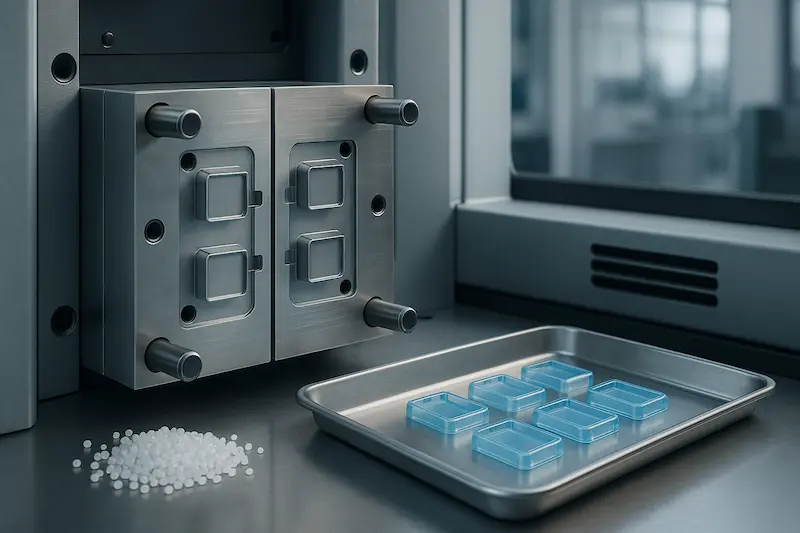
Short-run injection molding fills a specific gap in plastic manufacturing: projects that need production-quality molded parts but do not yet justify the tooling strategy used for stable, high-volume production. It can be useful for pilot batches, bridge production, replacement parts and products whose demand is still uncertain.
The economics depend on part geometry, resin, tolerances, tooling material and expected production volume. In industry usage, short run plastic molding generally refers to injection-molding programs built around relatively small batches, although there is no single quantity threshold that applies to every project.
The main trade-off is straightforward: a lower initial tooling commitment and greater room for design changes can come with a higher cost per part than mature high-volume production. Choosing the process therefore requires looking at the full production program rather than at batch size alone.
What Is Short-Run Plastic Molding?
Short-run injection molding does not have a universal production-volume cutoff. Depending on part geometry, material, tooling, tolerances and supplier economics, a short run may range from relatively small batches to several thousand parts.
What distinguishes the approach is that tooling and production are optimized for lower volumes and greater flexibility rather than exclusively for maximum mold life and the lowest possible unit cost at very large scales.
Tooling strategy is one of the main differences between low- and high-volume projects. Short-run programs may use aluminium or different grades of steel depending on the resin, tolerances, geometry and expected mold life. Aluminium can reduce machining time and initial tooling investment in suitable applications, but it is not automatically the best option for every part.
This makes short-run molding particularly relevant when a design is still evolving, demand is uncertain or a company needs molded components before committing to long-term production tooling.
How Short-Run Injection Molding Works
Although production volumes may be smaller, the fundamental injection-molding process remains similar. The main differences are usually found in tooling strategy, production planning and the economics of the project.
1. Product design
The process begins with a digital model, generally created with CAD software. Designers and engineers need to consider wall thickness, draft angles, part geometry, material behavior and other factors that affect whether the component can be molded consistently.
2. Prototype and validation
Before investing in an injection mold, a prototype may be produced through 3D printing or CNC machining. This can help evaluate dimensions, assembly, ergonomics or basic functionality before the molded version is manufactured.
A prototype does not reproduce every characteristic of an injection-molded component, but it can expose design problems while modifications are still comparatively easy to make.
3. Mold fabrication
The tooling material and construction method depend on the expected production volume and requirements of the component. Aluminium is frequently considered for lower-volume programs because it is easier to machine than many production steels, while steel tooling may be appropriate when greater durability or specific processing conditions are required.
Mold design also has to account for cooling, ejection, gates, vents and the way molten plastic will move through the cavity.
4. Injection molding
Plastic resin is heated and injected into the mold cavity. Once the material cools sufficiently, the mold opens and the component is ejected.
Producing consistent parts depends on controlling variables such as temperature, pressure, cooling and material preparation. The requirements change according to the polymer and geometry involved.
5. Finishing and inspection
Depending on the application, molded components can require trimming, assembly, coating or other secondary operations. Dimensional inspection and other quality controls may also be necessary, especially for parts with tighter tolerances or functional requirements.
Where Short-Run Molding Can Add Value
The strongest advantage of short-run production is not simply speed or lower cost. It is the ability to reduce the commitment required before a product or design has reached stable large-scale demand.
Product development and design changes
A lower-volume program can allow manufacturers to evaluate molded components before moving to longer-term production tooling. If testing reveals a design problem, changes may be easier to manage earlier in the program.
The actual cost of a modification, however, depends on what needs to change. Some alterations can be made to an existing tool, while others may require substantial reworking or a new mold.
Bridge production
A company may need functional molded parts while long-term tooling is still being developed or before demand is high enough to justify it. Short-run molding can serve as a bridge between prototypes and established production.
Market validation
Producing a limited initial batch can also reduce the inventory exposure associated with an untested product. Instead of manufacturing large quantities before demand is understood, companies can align production more closely with early requirements.
Replacement and specialized parts
Lower-volume molding may be useful for components with limited recurring demand, specialized equipment or replacement-part programs in which mass production would be difficult to justify.
Common Materials for Short-Run Molding
Material selection has a direct effect on mechanical performance, appearance, processing conditions and tooling requirements.
Common thermoplastics can include:
- ABS: widely used where impact resistance, dimensional stability and surface appearance are important.
- Polypropylene (PP): lightweight and chemically resistant, with applications ranging from consumer products to packaging.
- Polycarbonate (PC): used when impact resistance, dimensional performance or transparency is required.
- Polyamide (PA or nylon): suitable for many mechanical applications requiring wear resistance and strength.
- Polyethylene (PE): available in multiple grades for applications requiring properties such as chemical resistance, toughness or flexibility.
Projects with more demanding mechanical, thermal or chemical requirements may rely on engineering plastics for injection molding. These materials can also require closer control of factors such as moisture, processing temperature, shrinkage and mold conditions.
There is therefore no single resin that is best for short-run molding. Material selection has to follow the requirements of the finished component, rather than production volume alone.
Short-Run vs. High-Volume Injection Molding
The distinction between short- and high-volume molding is better understood as a production strategy than as a fixed quantity threshold.
| Aspect | Short-run molding | High-volume molding |
|---|---|---|
| Production volume | Lower, limited or uncertain volumes | Stable, repetitive high volumes |
| Tooling strategy | Lower initial commitment and room for iteration | Designed for durability and long production life |
| Tooling material | Aluminium or steel depending on requirements | Commonly more durable production tooling |
| Lead time | Can be shorter with simpler tooling | Usually involves a more extensive tooling phase |
| Design changes | Generally easier earlier in the program | Potentially more costly after production tooling is finalized |
| Unit economics | Fixed tooling costs are spread over fewer parts | Unit costs can fall as volume increases |
| Typical use | Pilot runs, bridge production, limited demand | Established products and large-scale production |
The appropriate transition point between the two approaches depends on more than the number of parts. Tool complexity, expected mold life, resin, quality requirements and the probability of future design changes can all affect the calculation.
When Short-Run Injection Molding May Not Be the Best Choice
Short-run molding is not automatically the most economical option for every low-volume project.
At very small quantities, processes such as CNC machining or additive manufacturing may avoid the cost of dedicated injection tooling altogether. At the opposite end, stable high-volume demand can justify more durable production tooling because the initial investment is distributed across a much larger number of components.
Part geometry, abrasive or high-temperature resins, tight tolerances and demanding surface requirements can also change the tooling decision.
Research into low-volume plastics manufacturing strategies has examined precisely this broader problem: the most appropriate production process changes according to volume, tooling requirements, material and part characteristics.
For that reason, expected quantity should be considered alongside total program cost, mold life, material requirements and the likelihood of future design changes.
Applications Across Industries
Short-run injection molding can serve industries in which molded components are required but demand, development stage or product specialization limits production volume.
Automotive
Possible applications include prototype components, test assemblies, replacement parts and limited-production components before a design enters larger-scale manufacturing.
Medical devices
Short-run molding can be used for prototypes and low-volume components intended for medical devices. In these applications, material selection, process validation, cleanliness, traceability and any required sterilization need to be evaluated separately according to the component and its intended use.
Producing a part through injection molding does not by itself make it sterile or suitable for medical use.
Consumer products
Product developers can use limited production runs to evaluate finished molded components, introduce variants or manufacture products for which demand remains uncertain.
Industrial equipment
Enclosures, mechanical components, protective parts and replacements for specialized equipment may be suitable for lower-volume molding when repeated production is required but quantities remain limited.
Aerospace and other demanding applications
Low-volume requirements also exist in industries with highly specialized components. In these cases, the production volume alone cannot determine process suitability: materials, documentation, tolerances, validation and application-specific requirements become central to the decision.
Technology Used in Short-Run Molding
Modern low-volume production can combine several manufacturing and engineering tools.
CNC machining is widely used for mold manufacturing and for prototype components. CAD and mold-flow analysis can help designers evaluate geometry and anticipate processing problems before production. Additive manufacturing may be used for prototypes, fixtures, inserts or particular tooling applications when its capabilities match the project.
Automation can also be incorporated into injection molding for handling, inspection or repeatable secondary operations.
The relevant question is not whether a technology is considered “rapid” or advanced, but whether it provides the required accuracy, mold life, material compatibility and economics for the specific production program.
Inventory and Sustainability Trade-Offs
Producing smaller batches can help reduce overproduction and unnecessary inventory when demand is uncertain, but that does not make short-run injection molding inherently more sustainable.
Environmental performance depends on several factors, including tooling, scrap rates, resin selection, energy consumption, transportation, product life and end-of-life options. Recyclability also varies according to the polymer, additives, contamination and the recycling infrastructure available where a product is discarded.
For manufacturers, one of the clearest potential advantages is therefore better alignment between production and actual demand, rather than assuming that every small batch automatically has a lower environmental impact.
What to Evaluate Before Starting a Short-Run Molding Project
Before choosing a manufacturing route, a project should be assessed through several related variables:
- expected initial and future production volume;
- part geometry and tolerances;
- resin and processing requirements;
- expected mold life;
- surface and cosmetic requirements;
- potential design changes;
- inspection or validation requirements;
- tooling investment;
- unit cost at the expected production quantity;
- alternatives such as machining or additive manufacturing.
Looking at these variables together is more useful than choosing a process based only on whether a batch is considered “small.”
Conclusion
Short-run injection molding is most useful when a project needs molded parts before the economics of high-volume production tooling make sense. Its principal advantage is not that it is always cheaper or faster, but that it can reduce the initial production commitment while preserving greater flexibility as a design or market develops.
The right choice ultimately depends on expected quantity, part geometry, resin, tolerances, tooling life and the likelihood that either the design or demand will change. Evaluating those factors together provides a more reliable basis for deciding between additive manufacturing, machining, short-run molding and full-scale injection molding.
Comentarios