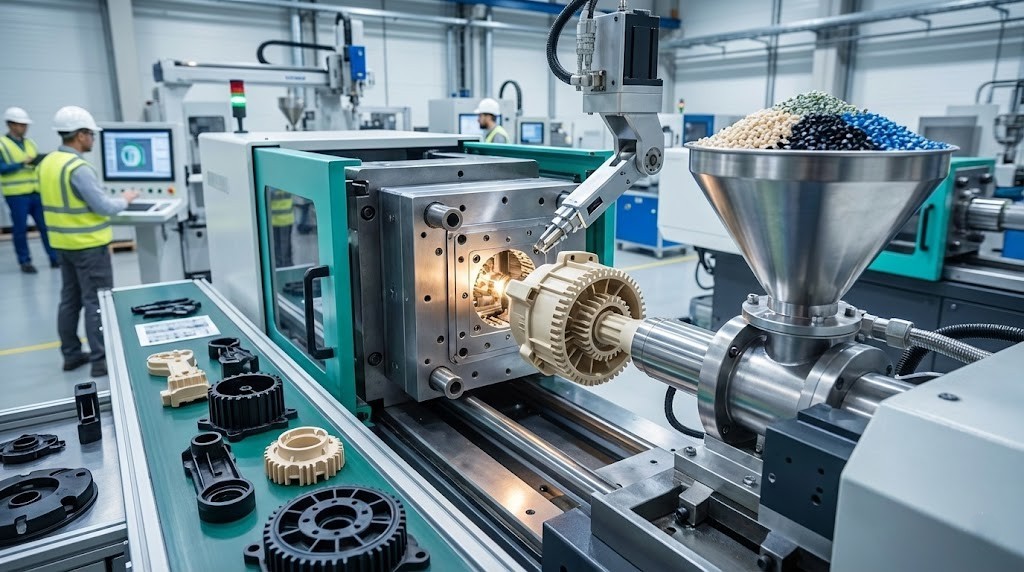
In the realm of modern manufacturing, injection molding stands as the most efficient process for producing high-precision, complex plastic components.
While general-purpose plastics (like PE or PP) dominate the packaging industry, Engineering Plastics are the «heavy lifters» of the industrial world. These materials are specifically designed to bridge the gap between low-cost polymers and high-strength metals.
I. Defining Engineering Plastics
Engineering plastics refer to a group of thermoplastic materials that possess superior mechanical, thermal, and chemical properties. Unlike commodity plastics, they are engineered to withstand environmental stresses such as high temperatures, corrosive chemicals, and physical impact over long durations.
In the context of injection molding, these materials are categorized based on their molecular structure, which dictates how they behave when melted and cooled:
- Amorphous Plastics: Characterized by a random molecular structure (e.g., PC, ABS). they offer excellent dimensional stability and transparency but are more susceptible to chemical stress cracking.
- Semi-crystalline Plastics: Characterized by highly ordered molecular patterns (e.g., PA, POM, PBT). These materials have distinct melting points and offer superior wear resistance and chemical stability.

II. Key Engineering Plastics in Injection Molding
1. Polyamide (PA/Nylon)
Nylon is the backbone of the automotive and industrial sectors. It is prized for its high fatigue resistance and toughness.
- Key Advantage: Excellent wear resistance and the ability to be reinforced with glass fibers to achieve metal-like stiffness.
- Molding Challenge: High hygroscopy (moisture absorption), which requires rigorous pre-drying to avoid hydrolytic degradation.
2. Polycarbonate (PC)
PC is the premier choice for applications requiring optical clarity and extreme impact resistance.
- Key Advantage: Virtually unbreakable and maintains properties over a wide temperature range.
- Molding Challenge: High melt viscosity, requiring high injection pressures and precise temperature control.
3. Polyoxymethylene (POM/Acetal)
Known as «plastic steel,» POM is the material of choice for mechanical components.
- Key Advantage: High stiffness, low friction, and exceptional dimensional stability.
- Molding Challenge: High shrinkage rates and potential for thermal decomposition (releasing formaldehyde gas) if overheated.
4. Polybutylene Terephthalate (PBT)
PBT is a semi-crystalline polyester widely used in the electronics industry.
- Key Advantage: Rapid crystallization (fast cycle times) and excellent electrical insulation properties.
- Molding Challenge: Sensitivity to uneven cooling, which can lead to warpage in large parts.
III. Critical Considerations for Injection Molders
Processing engineering plastics is significantly more demanding than processing commodity resins. Engineers must focus on three technical pillars:
1. Thermal Management
Engineering plastics often require high mold temperatures (up to 150°C or higher) to ensure proper crystallization and surface finish. Failure to maintain a consistent mold temperature can result in internal stresses and premature part failure.
2. Moisture Control
Many engineering resins are polar and absorb moisture from the air. Even 0.02% moisture content can cause «silver streaks» (splay) on the surface and drastically reduce the mechanical integrity of the polymer chains.
3. Shrinkage and Warpage
Semi-crystalline materials shrink significantly more than amorphous ones. Engineers must use Mold Flow Analysis (MFA) to predict how the material will shrink and where the «knit lines» (weld lines) will form, as these are often the weakest points of a molded part.

IV. Strategic Applications
- Automotive: Engineering plastics are central to «metal replacement» initiatives. Under-the-hood components, such as intake manifolds and cooling fans, use glass-filled PA66 to reduce vehicle weight and improve fuel efficiency.
- Medical Devices: Materials like PEI (Polyetherimide) are used for surgical instruments because they can withstand repeated sterilization in autoclaves without losing their structural integrity.
- Electronics: High-flow engineering plastics allow for the molding of ultra-thin connectors and housings for smartphones and laptops, where flame retardancy (UL94-V0) is a mandatory requirement.
V. Future Trends: Sustainability and Specialty Grades
The industry is currently pivoting toward Sustainable Engineering Plastics. This includes the development of bio-based polyamides (derived from castor oil) and post-consumer recycled (PCR) grades that maintain the high-performance specifications of virgin resin. Furthermore, the rise of Specialty Polymers like PEEK and PPS is pushing injection molding into the «extreme» territory—replacing stainless steel and titanium in aerospace and oil-and-gas applications.
Conclusion
Engineering plastics for injection molding represent the pinnacle of polymer science. By selecting the right resin and mastering the complexities of the molding process, manufacturers can produce parts that are lighter, more durable, and more cost-effective than traditional materials.
Comentarios